If you were going today on https://trials.dynamics.com/, you finally could find possibility to run trial Business central.
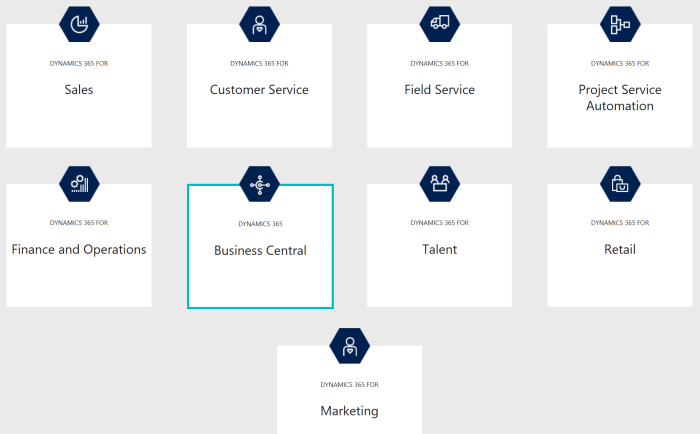
You just need your email and phone number. I hope you will try it and discover a lot of a nice features.
If you were going today on https://trials.dynamics.com/, you finally could find possibility to run trial Business central.
You just need your email and phone number. I hope you will try it and discover a lot of a nice features.
As we already had insight in Dynamics 365 Business Central and this solution will be available in only three days, it is a moment to get more information about licensing. In this post I’ll show only the basic important topics regarding licensing.
As we already know, there are three licensing types Premium, Essential and Team Members. Premium and Essential will provide full access to solution, but not to the same level of features. Essential has most of the future, but not Manufacturing and Service Management (this is included in Premium package). And very important thing is that we cannot use a mix of these two user types. You must choose what level of features you need and all full users must use the same license type.

As a Team Member, you can do the following:
And more, it is important to know that the minimum number of full users is 1 and w don’t have a maximum number of users (you can register number of users you need). But keep in mind, we are talking about named users, not concurrent.
And Dynamics 365 Business Central Essential, Dynamics 365 Business Central Premium and Dynamics 365 Business Central Team Members also includes the PowerApps for Dynamics 365 Applications license.
Dynamics 365 Business Central users are not provided with any standalone or general-purpose Power BI license or use rights, but this subscription includes an option to embed Power BI content as a product feature but require users to subscribe to Power BI separately to configure access to this content.
And with a question what we have more included, this is important table:
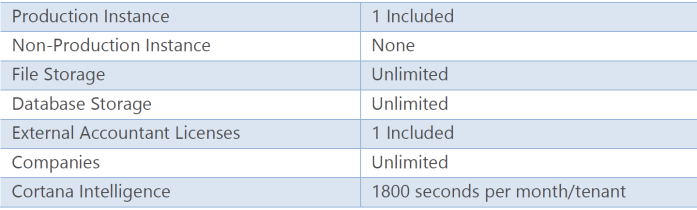
Customers who wish to expand beyond the default subscription capacity included in Dynamics 365 Business Central will need to have a separate Azure subscription.
But on the end as very important: please do not use this article as license manual. If you need more details for licensing of real or potential customers, please use an official Dynamics 365 Business central Licensing Guide.
When you run your Dynamics 365 Business Central for the first time, you will see new refreshed Web Client. Well, I think we will get some more small features soon (but just small polishing). Anyway, everything is easy for navigate and everything is exactly where you expect to be. And everything works very smoothly. I think the first what we can see are the messages in the left part of screen, with the most important information (the first will be “Good afternoon…”, but after that information).

Now we have a main menu on the top of the screen. Depends what we choose, we will get submenu just below the first row. Again, depends of the number of commands, we will get just one or more rows.

But we also have a lot of the most important actions on the right side of the page. Then we can see information and tiles in the activities and there are ordered noticeable. If you click on ‘See more’ or on some tile, you will open additional information (the same thing s with the large message on the left top part of screen).
We can also find “Product videos” and “Get started” links. On “Product videos”, you can find a few interesting videos about product, but more interesting is “Get started”. OK, we can find some educated videos again, but we have something more interesting – Role Centers link. With this, we can Explore different business roles features.
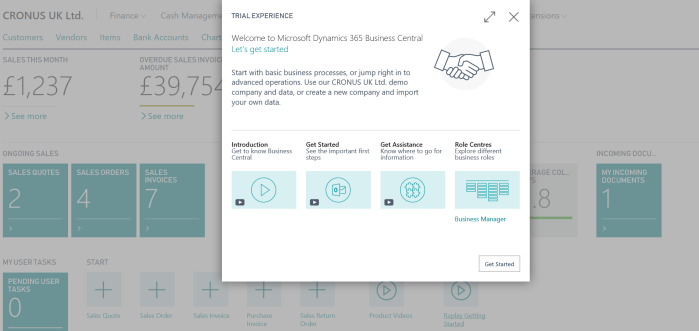
If you run it, you will get new window where you can choose all available role centers as an option and see what features are covered with each of them as the main menu structure (for each of them, you will see small tooltips with the basic information). And even more, if you click on Continue, you can change your role center; and again you don’t need to make logout/login, because system will change your role center automatically.
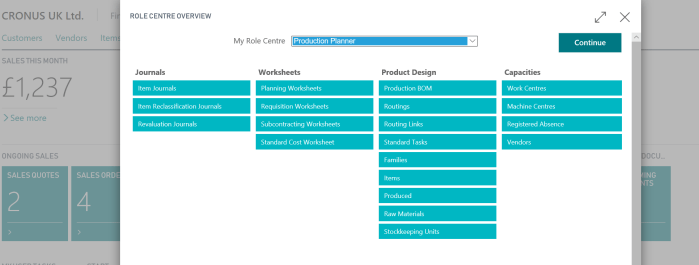
Of course, you can change your role center using ‘My Settings’, but guess… you will run the same page as I already showed. Really good user experience.
Then, when you run some page, from menu… for example customer, you can choose if you want to unpin the top menu… just to get little more space. Of course, you can chose the view type and so. But everything is so modern and provides really good experience.

OK, this is just beginning. This is still not even the first impression. But I don’t like to write so big texts. I’ll continue soon with more details.
A few days ago, Microsoft published Whitepaper about GDPR regulations and NAV as well as package of new Cumulative Updates where the first part (DataClassification property) on these changes were implemented.
Day after this was published, we could find a new article with more details how to work with classified data and new DataClassification property in tables and fields.
I don’t want to retype all these details, because you can find all these information on NAV Team blog as well as complete documentation about data classification. I’ve just wanted to spread a word. Again, all details about new CU’s and how to implement GDPR requirements can be found on a NAV Team blog.
Today is Sunday and I’m seating on the airport waiting my flight to Bangkok. I just few days Directions ASIA 2018 will start. This time, it will be one of the most important conferences in Dynamics NAV world.

Why it will be so important? On this conference we will see the new product with still code name – Dynamics 365 ‘Tenerife’. As we already know, this solution will be full Dynamics NAV on a cloud as full SaaS solution. But we will get the same on-prem product, with the same code base – Dynamics NAV 2018R2. From my point of view, I’m primarily waiting SaaS solution and I expect it will be much more significantly for Dynamics world. In this moment I don’t want to write anything about news in this solution, because we will get officially information in only few days. I’ll be there and I’ll publish the most important news announced on Directions.
Also, we will see some news from CRM world (Sales and Marketing), especially from SMB area. It will be very important in the future of business applications, because we can offer common solutions to cover all requirements in specific companies.
As I’ve already wrote, Dynamics 365 for Marketing Public Preview has been announced. Also, in my previous blogs I wrote about Click Dimensions Marketing solution for Microsoft Dynamics 365 for Sales, and this time I want to take an opportunity to show you something new in this new D365 for Marketing Public Preview solution.
I have been testing Dynamics 365 for Marketing for a while, and I’ve found one interesting feature named as ‘Check for Errors’. This feature looks like really good functionality because you can check if everything is fine with your Marketing Customer Journey, or Email Template, or something else before you go live with it.

Checking process will take only a few seconds, and until this checking done, you can’t do any other thing, but still it is only a few seconds. 🙂
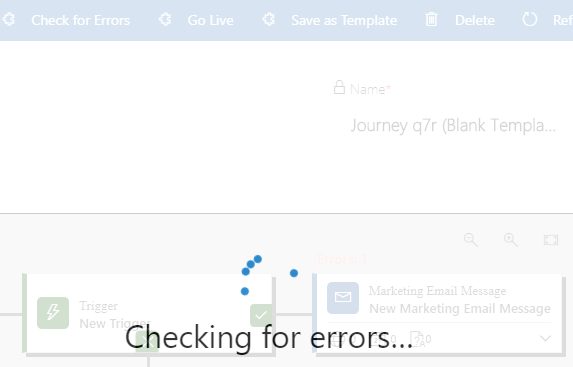
After system has checked your configuration, it comes with even better things. As the first, system shows you a notification bar where you can see where to look for an error.

After going to the place where error is, the system will show where your error is placed, or if there is a few more errors you will see the places where they are, as in my example.
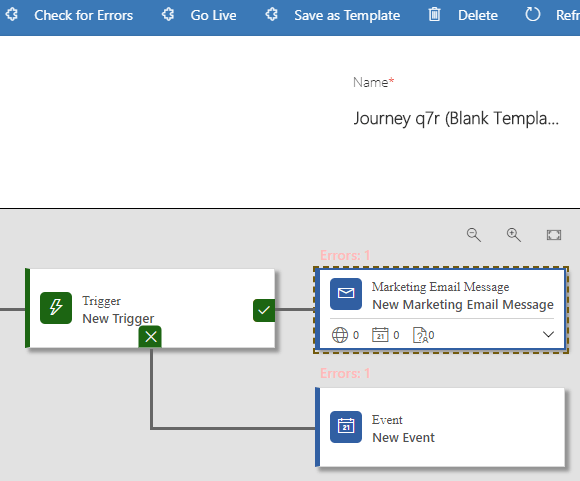
In my example I have one error in two campaign parts. With going to the properties of each campaign part, you will see exactly where you did a mistake.
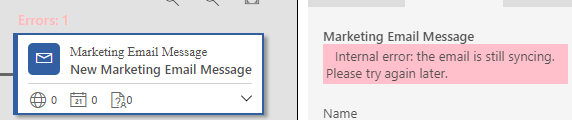
After testing a little while Dynamics 365 for Marketing Public Preview, I’ve found this interesting thing, and I wanted to share it with you. This shows that the new Dynamics Marketing app is very interesting for using and testing.
Few days ago, Dynamics 365 for Marketing Public Preview finally has been announced. For those of you who already attended on some of Dynamics events, this was expected moment.
If you want to try it, go to this URL: https://trials.dynamics.com/Dynamics365/Preview/Marketing and you just need to use work email and phone number for verification:
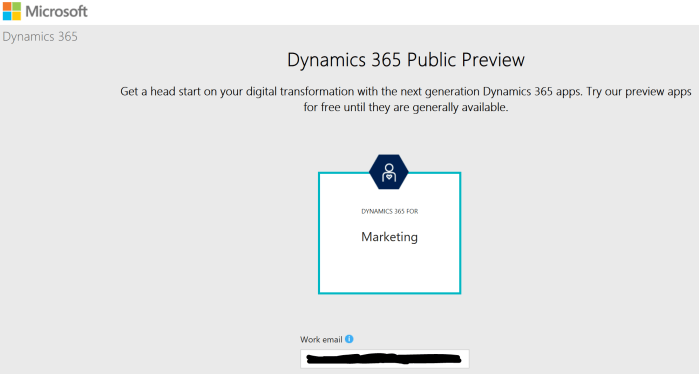
The second step will be accepting trust to the Microsoft CRM Services as publisher…

When you finish registration, you will get the main Dynamics 365 for marketing landing page:

Now, you have possibility to run ‘First time setup’ and finish this configuration and continue to work with this app after that. In the following texts, we will write more about them.
The main features covered with this App are:
In a last period, I’ve got a lot of questions about how to make a proper licensing for Dynamics 365 for Talent. As it is a new solution, it is understandable. As I’ve already wrote a few articles about this product, I think I can help with some answers.
The first and very important, all users in this solution are named users. And if we speak about HR core part, we have two different user types and you can buy them on two separate ways. We have Full Users with total access to all HR core application and we have Team Members with very limited access (mostly, but not only for read tasks).
As I mentioned Full Users (Talent Users) can be bought on the following ways:

If we are speaking about Team Members, you can buy them for 8 USD, but again you will not get only access to Talent with them, but also to all other Apps in Dynamics 365 package. As I mentioned, Team Member are not limited only with read rights, because you can use them for example as employee for Employee Self Service.
OK, but this is not the end. Recently, Microsoft announce two additional AI Apps for Talent (Attract and Onboard) and that means if you want to use them, you first must be a regular Talent User. Then, you can subscribe them. Price is 8 USD for each of them separately or if you want both, price will be 12 USD in total.
And again, this is not the end. Actually, it doesn’t mean it must be the end. Why? Because if you want to customize something. As you already know (I hope), this App is full SaaS and you cannot just open a code and change it. If you want to change something on forms and similar, you can do it using PowerApps. In this case person who will make these customizations must have PowerApps Plan 2 (40 USD) license, but other users who will use these forms, have to have minimum PowerApps Plan 1 (7 USD) license. That means, not all users, only these who will use these new features. And just to know, if you are buying some Dynamics Plan, you will get PowerApps for free.

And again, it is similar situation if you want to use PowerBI for additional reports or Flow for additional workflows.
I hope I covered all models of licensing here. But just keep in mind, it is possible to be some changed, because it is a new App in Dynamics 365 family and with new releases, it is possible to be some changes. And I didn’t mentioned, but just to be sure: all pries are on monthly basis.
In my previous blog about making marketing campaign automation in Click Dimensions, I just wanted to cover top processes and share an idea how I solved this requirement. But when you know what you want, creating Marketing Campaign Automation in Click Dimensions is not so complex, and now I’ll show you how to do it, but this time step-by-step.
Marketing List
I prefer to start with creating Marketing List, because you will use it in creating automation, and it won’t be a good idea to forget it.
So, everybody who has ever used Microsoft Dynamics 365 for Sales knows how to create marketing list, but I will explain it in a few sentences. First you are going to the Marketing card, and in the row Marketing you will see Marketing Lists. After entering the marketing list, you need to fulfill what is necessary in creating marketing list.
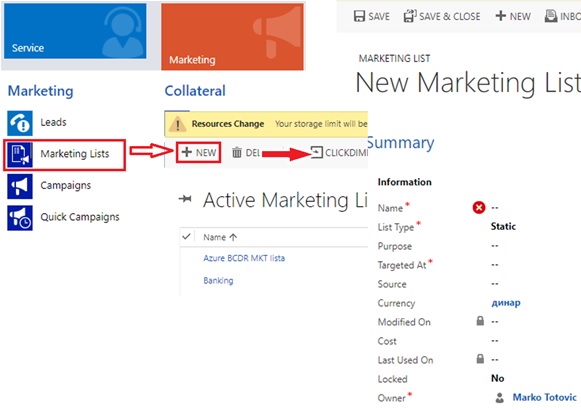
I will not be so long on this, but everything is shown on pictures, so if somebody is doing this for the first time please follow the pictures.
Email Templates
Now we are coming in to Click Dimensions, so who have not ever used Click Dimensions I will explain everything step by step, and for those who already use Click Dimensions, maybe you will learn something new.
So, Click Dimensions is located on Marketing card, so you are probably figuring that we won’t go out of Marketing card in creating this automation. Let’s go back on creating, first we have to create Email Template. We are going to row Email Marketing, where we will find and enter it to the Email Templates.
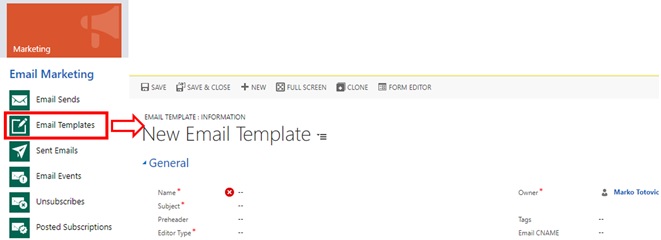
After we entered this, we are starting with creating an Email Template, so we first have to fulfill necessary data, and then click on Save (as creating everything in Dynamics 365 for Sales). After saving your data you have to enter this in the editor to really create template.
In editor, way of working is ‘drag & drop’, so it is easy and intuitive. So, you need to choose what you will put in your email, and just save it.

Depends on how many emails you want to send in one automation, you have to create as much email templates.
Campaign Automation
As you see this is going pretty easy and fast. So, we’ve came to the main thing in this step by step explanation. So, we are still on Marketing Card, and this time we are going in row Marketing Automation where we have to enter only one thing we have in this row, and that is Campaign Automation.

After entering it you just need to begin with creation of regular New Campaign Automation. After you open a Campaign Creator, you will see that the only thing that is mandatory to fulfill is the Name of this Campaign, and after typing the name we just must save this, and to be prepared to go into the Builder where we will create the campaign.
Builder
Builder is placed on the ribbon inside of Campaign Automation you’ve created, and you have to enter it from the start with creating with your automation.

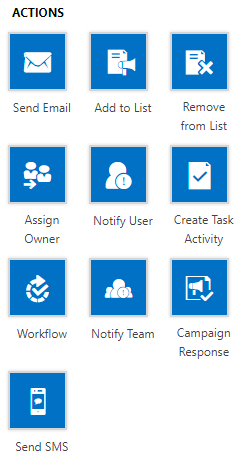
The Builder is intuitive created, and you can work easy through this process. It has ’Triggers’, ’Actions’, ’Timers’, and ’Series’. In this text I will explain how to use only some of the triggers, and actions.
So, we will start with trigger ’Added to List’ and this works as drag & drop, so you just have to choose what you will use and to move it to white background. And after starting with our trigger, we will add the next one as action, and in this example, this action will be ’Send Email’.

After doing this, we will again use one trigger, and not this is an ’Email Interaction’. And just to know, when trigger is not used on the beginning of the whole design it will have ’yes’ and ’no’ conditions sides. It is important to know that you can’t finish with opened any of these sides of trigger, without actions. So, it is better to have the trigger on the beginning (to avoid thinking what actions to put on both of sides). After we add our second trigger, we will first focus on our ‘true’ side. Because it is some email campaign we will use in ‘true’ side action ’Assign Owner’ and in ‘false’ side ’Remove from List’. Now we have just created what campaign will do, and you just have to fulfill some more information and we have finished.
First by clicking on first trigger ’added to list’ you will see on the right side that instead of triggers and actions something new appear, and in that place in first trigger, you just have to bring your marketing list which is mandatory, and to check check-box for ’Run on entire list’. That means that this automation will collect all your contacts from your marketing list, but if you type in some new contact, this automation will automatically add it to list.
After this is finished, we are going on our action in the same way by clicking on it. Now you will have to type some more information, but not so much. Mandatory is to select which email template you want to use in this automation, so you will use one you have created on the beginning. After that you have to type in subject, and to choose from which name and email address this mail will be sent.
After that, you have to go on the next trigger, and you have to choose from which series the email will be sent, and in can be only that you’ve used in a step before. After that you have to choose what is an interaction you want to monitor (email clicking, or email opened). In this example, I’ll use clicking. And only timer configuration is left if you want to use it. I’ve set here on the timer that if in 3 days nothing happens that this interaction is going in to ‘false’ side.
If condition is positive, we’ve put action ’Assign Owner’ and setting up of this action is easy. You have just to choose a display name, and to type which user will be assigned if somebody open our email.
If our condition is negative, it is similar. You just have to choose from which list you want to delete if somebody didn’t respond to campaign. Of course, it will be the list from which you have started. This is because, as I already mentioned, we must have action on the end of each condition.

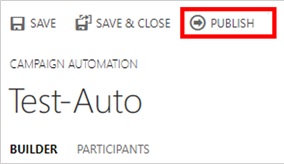
And we finally arrived at the end. It just left to save this, and after saving, you just have to click ’PUBLISH’ and whole Campaign Automation is starting, as your email is sent.
Today I had a challenge or maybe opportunity 😊 to set up marketing automation process in Click Dimensions Campaign Automation for the first time. This is reason I want to share this experience with you.
In the beginning it looked pretty easy, and I just needed to create few email templates (it depends how much templates we need), after that I have to create marketing list and to create new campaign automation which look pretty easy because it works on the first sight as Microsoft Flow, just with less actions and triggers.
As I said, looked quite easy. When you enter the campaign automation builder, it looks like you will finish just in a few minutes, and you will do it, just if you know some “secret weapons” 😊.
Of course, every time when you are working with some kind of workflows, you must start with triggers, and to continue with actions and triggers in combination as much as you need. But in my case, I had to start with email trigger and as much as I wanted to finish it, it always made some issues. After a few attempts I realized that my email triggers have a problem in that it doesn’t know which email to use. But if you want to begin with saying this mail you will use is not possible to use because this is an action, and of course you can’t start with an action…

After a lot of thinking and trying to get over this problem, because there are not a lot of triggers I realized that I must begin with Manual Entry (which is note normal to use, when you have a few hundreds or thousands emails to enter in list), and that was a problem. But as I said in the beginning of this article, it is not hard to work in Click Dimensions campaign automation, but you have to know some things, and I realized that the best way was to start with marketing list triggers entry and it finally started working.
Then it came to the next problem, but this time on the end, because we must close the triggers. Just to be clear, in Click Dimensions Campaign Automation, at the end of builder, you must put the action, so again it was problem to realize which action would be normal to use; when you compare it with Microsoft Flow, it can be little bit confused, because Flow doesn’t require it. If I use email action again, it will be in some circle which could never be closed, and further I didn’t want to delete someone from my marketing list because they didn’t answer to this campaign, because they will maybe respond at the next, and my trouble continues. But I realized that there is no other way to close it except of using ‘remove’ from the list action. Again, I had to get over new problem to finish this campaign automation, and with little thinking I remembered to create the clone of my marketing list and to use it from beginning of my campaign automation process, and in that way, I will keep my marketing list on original one.
These problems took me some time, but after resolving all of them, I found out that using of Click Dimensions Campaign Automation process if quite easy, but you need to try few times before it works, and after some time of using it often you will really create every Campaign Automation in few minutes.

 Totovic Dynamics 365 Blog